

Intermittent Fasting
In recent years, fasting, or intermittent fasting, has become one of the most talked-about topics in nutrition and health. From social media to scientific journals, everyone is discussing it. Some see it as the key to weight loss, youthfulness, and longevity, while others dismiss it as dangerous and unfounded. As is often the case in science, the truth lies somewhere between these two extremes.
In this article, drawing on research findings, we explain what fasting is, what happens in the body, which benefits are supported by reliable evidence, which claims are exaggerated, and who should avoid it. Our goal is to help you make an informed decision, free from the influence of hype.
What Is Fasting?
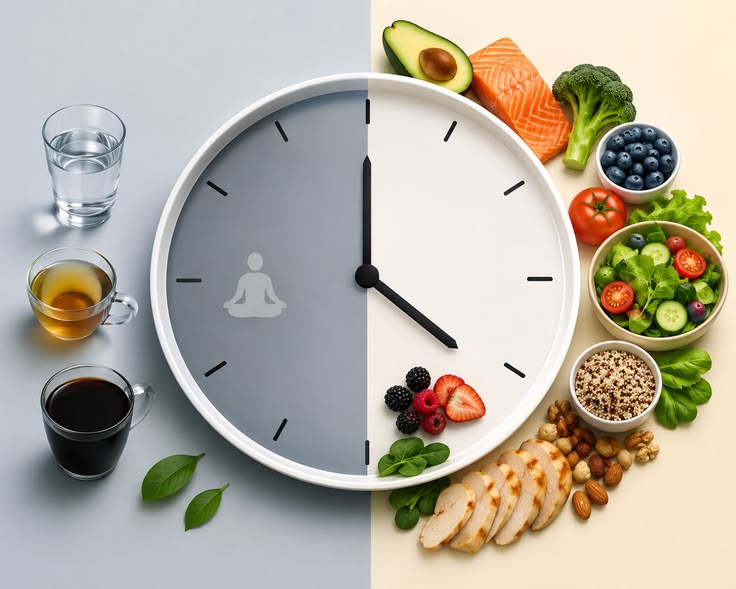
Fasting means deliberately and intentionally abstaining from food and caloric beverages for a defined period. Fasting has a long history in many religions and cultures, but “intermittent fasting” as a dietary pattern has been the subject of scientific research only over the past two decades. The most common patterns are:
- Time-restricted eating: For example, the 16:8 pattern, in which all meals are eaten within an 8-hour window, leaving 16 hours of fasting. Sometimes a 10- or 12-hour eating window is chosen, which is gentler.
- The 5:2 pattern: You eat normally five days a week and, on two non-consecutive days, reduce your intake to roughly 500 to 600 calories.
- Alternate-day fasting: Normal days and very low-calorie days alternate.
- Longer fasts: Fasting for 24 hours or more. These carry greater risks and should always be done under medical supervision.
It is important to note that most studies have been conducted on relatively healthy adults, often those who are overweight. Their results cannot be generalized to all groups without caution.

What Happens in the Body?
The Fed State
To understand the effects of fasting, we need to know where the body gets its energy. After each meal, carbohydrates are broken down into glucose, and the hormone insulin is released to move glucose into cells. Part of the glucose is stored as glycogen in the liver and muscles, and any excess can be converted to fat. In this state, insulin levels are high and the body burns mostly glucose.
The Fasted State
As several hours pass since the last meal, blood sugar and insulin levels fall, and the body draws on its stored glycogen. As fasting continues and liver glycogen declines, the body gradually shifts toward burning more fat. The liver converts fatty acids into molecules called ketones, which the brain and muscles can use for energy. Researchers call this transition the “metabolic switch.”
The exact timing of this switch differs from person to person and depends on the composition of the last meal, physical activity, and individual characteristics. A noticeable rise in ketones is usually seen after 12 hours or more of fasting. In shorter fasts, the change may be very mild.
Autophagy: Fact and Exaggeration
Autophagy (“self-eating”) is a natural process in which cells recycle their worn-out and damaged components. The discovery of its mechanisms earned Yoshinori Ohsumi the Nobel Prize in Physiology or Medicine in 2016. Studies in laboratory organisms have shown that fasting can increase this process. However, measuring autophagy in humans is difficult, and direct evidence about its extent and consequences in the human body remains very limited. Claims such as “after X hours of fasting, your cells are completely cleansed” therefore lack sufficient scientific support.
The Circadian Rhythm
One intriguing area of research is the relationship between meal timing and the body’s internal clock. Metabolism does not work the same way at all hours of the day; for example, insulin sensitivity is generally higher in the morning than in the evening. For this reason, some researchers believe that eating earlier in the day may be better for metabolism. Even so, the evidence in this area is still developing, and there is no definitive, universal recommendation.
Potential Benefits: How Well Are They Supported?
Weight Loss
Many studies have shown that fasting can lead to weight loss. However, more rigorous reviews and clinical trials indicate that the weight loss it produces is generally not significantly different from that achieved with conventional calorie-restricted diets. A randomized trial published in JAMA Internal Medicine in 2020 found that eating within an 8-hour window did not produce significantly greater weight loss compared with a control group.
The main advantage of fasting appears to be that, for some people, following a simple time-based rule is easier than counting calories, so they end up eating fewer calories without really trying. For people who find this rule difficult, fasting offers no advantage and may even be unpleasant.
Blood Sugar and Insulin Sensitivity
Some studies have reported improved insulin sensitivity and lower fasting blood sugar. One small study of men with prediabetes found that eating earlier in the day can improve insulin sensitivity. However, the sample size was small, and the results alone are not conclusive. It should also be emphasized that people with diabetes, especially those taking medication, should not fast without medical supervision.
Blood Pressure and Blood Lipids
Some studies have shown small reductions in blood pressure or improvements in certain blood lipid markers, but results are inconsistent across studies, and much of the improvement is probably due to weight loss rather than fasting itself.
Brain Health
In animal studies, fasting has been associated with protective effects on nerve cells. In humans, however, there is not enough evidence to draw conclusions about preventing or treating brain diseases. This area is still at the research stage.
Heart Health and Longevity
In animal studies, calorie restriction and fasting have been linked to longer lifespan, but this result cannot be directly applied to humans. For heart health as well, there is not yet enough long-term research. A preliminary observational analysis in 2024 raised the possibility that eating within a very short daily window is associated with a higher risk of cardiovascular death. It should be noted that observational studies cannot establish cause and effect, and this finding needs further investigation. Still, it shows that fasting should not yet be regarded as a safe, proven approach for everyone.

Common Beliefs: True or False?
“Fasting boosts your metabolism.” There is no reliable evidence for this claim.
“Fasting puts your body into starvation mode and ruins your metabolism.” This claim is also inaccurate. Short-term fasts do not meaningfully slow metabolism. That said, long-term weight loss by any method can slightly reduce the body’s energy expenditure.
“Fasting detoxifies the body.” The human body has its own detoxification systems, namely the liver and kidneys, and there is no evidence that fasting specifically enhances their function.
“Breakfast is the most important meal of the day, and skipping it is harmful.” This has not been conclusively established. Randomized trials have not shown that skipping breakfast is harmful for everyone, or that eating it is beneficial for everyone. What matters is the quality and quantity of total daily food intake.
“Fasting cures diseases.” There is not enough evidence that fasting can replace medical treatment for conditions such as diabetes or cancer. Patients should never abandon their treatment because of fasting.
“Fasting during Ramadan is the same as intermittent fasting.” The two are not identical. During Ramadan fasting, drinking water is also prohibited during the day, whereas in fasting protocols, water is permitted and even essential. People with underlying medical conditions should consult a doctor before fasting during Ramadan as well.

Risks and Possible Side Effects
The most common side effects of fasting, especially in the first weeks, include headache, intense hunger, irritability, weakness, dizziness, constipation, and poor concentration. If not enough water is consumed, there is also a risk of dehydration.
Some people overeat after a fasting period, which can cancel out the positive effects and create an unhealthy cycle. This is especially important for people with a tendency toward unhealthy eating behaviors.
Rapid weight loss, by any method, can also increase the risk of gallstones. If protein intake and strength training are inadequate, part of the weight lost may come from muscle mass, which is undesirable for bone and muscle health, particularly at older ages.
Finally, the effect of fasting on sleep, mood, and athletic performance varies from person to person. Some people feel more energetic, while others become tired and listless.
Who Should Not Fast?
The following groups should avoid fasting or do it only under a doctor’s guidance and supervision:
- Pregnant and breastfeeding women
- Children and adolescents who are still growing
- People with a history of eating disorders such as anorexia nervosa or bulimia nervosa
- Underweight or malnourished people
- People with diabetes, especially those using insulin or certain blood-sugar-lowering drugs, because of the risk of severe hypoglycemia
- People with gout or a history of gallstones
- Frail older adults, people with chronic illnesses, and those taking medications that must be taken with food
- Patients undergoing intensive treatments such as chemotherapy
- Professional athletes during heavy training periods, unless following a specialized plan

Fasting and Exercise
Many people ask whether it is possible to exercise while fasting. The answer depends on the type and intensity of the exercise. Light to moderate activities, such as walking or yoga, are tolerable in a fasted state for most healthy people. However, intense or prolonged workouts may cause reduced performance, dizziness, and weakness while fasting.
If your goal is to maintain or build muscle, getting enough protein in your eating windows becomes even more important. It is better to schedule heavier training at a time when you can eat a proper meal soon afterward. If you feel severe dizziness or weakness during exercise, stop.
Practical Tips for Getting Started Safely
If, after consulting your doctor, you decide to try fasting, a few simple principles can help:
- Start slowly. Begin with a 12-hour fasting window and, if you tolerate it well, extend it gradually.
- Drink enough water. During fasting hours, water, plain tea, and coffee without sugar or milk are generally fine.
- Food quality matters more than timing. In your meals, include adequate protein, vegetables, fruit, whole grains, legumes, and healthy fats.
- Avoid compensatory overeating. The goal of fasting is not to make up for fasting by eating excessively.
- Don’t neglect physical activity and sleep. Regular exercise, especially resistance training, helps preserve muscle mass, and adequate sleep is essential for regulating appetite.
- Be flexible. Fasting should not disrupt your social life or relationships. If you can’t follow the plan one day, that’s fine; simply continue the next day.
- Listen to your body. If you experience severe dizziness, palpitations, trembling, blurred vision, or significant weakness, end your fast, and see a doctor if symptoms persist.
Frequently Asked Questions
Can I drink coffee while fasting? Yes, plain coffee without sugar or milk is usually fine. However, in some people it may cause stomach discomfort.
Is it a problem to take supplements while fasting? Some supplements, such as fat-soluble vitamins or iron, are best taken with food. Consult your doctor or pharmacist about this.
How long does it take the body to adapt to fasting? Usually a few weeks. During this time, mild hunger and weakness are common and gradually diminish.
Is fasting suitable for everyone? No. As noted, certain groups should avoid it, and each person should consider their own circumstances.
Conclusion
Fasting is a tool, not a miracle. Current evidence suggests that for some people it can be an effective way to manage calorie intake and improve certain metabolic markers, but its definitive superiority over other diets has not been established, and long-term research is still ongoing. More important than when you eat are the overall quality of your nutrition, physical activity, adequate sleep, and a sustainable lifestyle.
The best eating pattern is one that is safe, practical, and sustainable for you. Before starting any fasting program, especially if you have a medical condition or take medication, be sure to consult a physician or a registered dietitian.
Note: This article is for educational purposes and is not a substitute for medical advice.
No comment